

New Workplace Exposure Limits: What Changes In 2026 and What It Means For Diesel Dependent Industries
From 1 December 2026, Australia's Workplace Exposure Standards (WES) for airborne contaminants are replaced by Workplace Exposure Limits (WEL) - legally enforceable hard ceilings for airborne contaminants in the workplace. The rename is deliberate: these are not targets or guidelines. They are limits that cannot be exceeded.
For businesses that operate diesel-powered equipment, the most consequential change in the new WEL list is the introduction of a formal limit for diesel particulate matter (DPM) - for the first time in Australia.
WES → WEL: More Than a Name Change
The WEL transition tightens limits across all major diesel combustion by-products simultaneously. These are not minor adjustments. A greater-than-90% tightening on nitric oxide and greater-than-95% reduction on sulphur dioxide represent a complete reset of what was previously considered acceptable in Australian workplaces. For any operation running fossil diesel in an enclosed or semi-enclosed environment, meeting all of these limits at once is a substantial challenge.
| Contaminant | WES TWA* | WES STEL | WEL TWA* (from Dec 2026) | WEL STEL (from Dec 2026) | Change |
|---|---|---|---|---|---|
| Diesel Particulate Matter (DPM) respirable elemental carbon |
N/A | N/A | 0.01 mg/m³ | N/A | New substance added to list |
| Carbon Monoxide |
30 ppm / 34 mg/m³ | N/A | 20 ppm / 23 mg/m³ | N/A | ~33% reduction in limits |
| Nitric Oxide |
25 ppm / 31 mg/m³ | N/A | 2 ppm / 2.5 mg/m³ | N/A | >90% reduction in limits |
| Sulphur Dioxide |
2 ppm / 5.2 mg/m³ | 5 ppm / 13 mg/m³ | N/A | 0.25 ppm / 0.65 mg/m³ | 95% reduction in STEL |
| * TWA: 8-hour time-weighted average limit. * STEL: short-term exposure limit. WEL limits apply to airborne concentrations only. Source: Safe Work Australia Workplace Exposure Limits for Airborne Contaminants, effective 1 December 2026. Summary only and produced by RD2Go - consult the full WEL list for your specific obligations. | |||||
The Diesel Particulate Matter (DPM) Limit - Why It’s a Big Deal
Prior to WELs, there was no national WES specifically for diesel particulate matter (DPM) or respirable elemental carbon (REC) in general workplaces. Mining and some heavy industries followed standard guidance for sub-micron elemental carbon, but general sectors lacked a mandated limit, relying on broader risk management.
The new DPM limit of 0.01 mg/m³ (respirable elemental carbon, 8-hour TWA) applies to every Australian workplace operating diesel engine -underground mines, construction tunnels, transport depots, plant rooms, and generator facilities. There is no industry carve-out. Non-compliance risks fines, shutdowns, and health claims from lung issues tied to long-term exposure.
In many real-world operations running conventional fossil diesel, particularly in enclosed environments, measured DPM levels routinely exceed this threshold. The NSW coal industry's Standing Dust Committee has explicitly stated that this WEL "will require significant improvements in DPM exposure control at NSW coal mines, particularly during longwall relocation activities." If the industry body for one of Australia's most safety-conscious sectors is flagging it as a major challenge, operators across all diesel-intensive industries should take note.
Three strategic pathways exist for organisations that need to respond:
Upgrade machinery - replace existing diesel engines and plant with newer, lower-emission models. This can equate to high capital cost and significant operational disruption.
Implement engineering mitigation - enhance ventilation, install diesel particulate filters, upgrade exhaust treatment systems. Also costly and disruptive.
Switch to a lower emission fuel alternative - replace fossil diesel with HVO renewable diesel. No fleet changes, no downtime, immediate effect from the first fill.
For most operations, the third option is the fastest, lowest-cost, and lowest-disruption path to compliance.
HVO Delivers Massive PM Reductions - The Testing & Results
RD2Go's Hydrotreated Vegetable Oil (HVO) renewable diesel cuts particulate matter emissions dramatically when compared to regular diesel in real-world tests, thanks to its pure hydrocarbon structure.
Energy Power Systems Australia Pty Ltd (EPSA) conducted occupational DPM testing at the same site across three fuel scenarios between July and December 2025 using RD2Go Renewable Diesel. Same site. Same equipment. The only variable was the fuel. The results are unambiguous: standard fossil diesel produced DPM at 2.5 times the incoming WEL, whilst full HVO substitution brought DPM to below detection threshold.
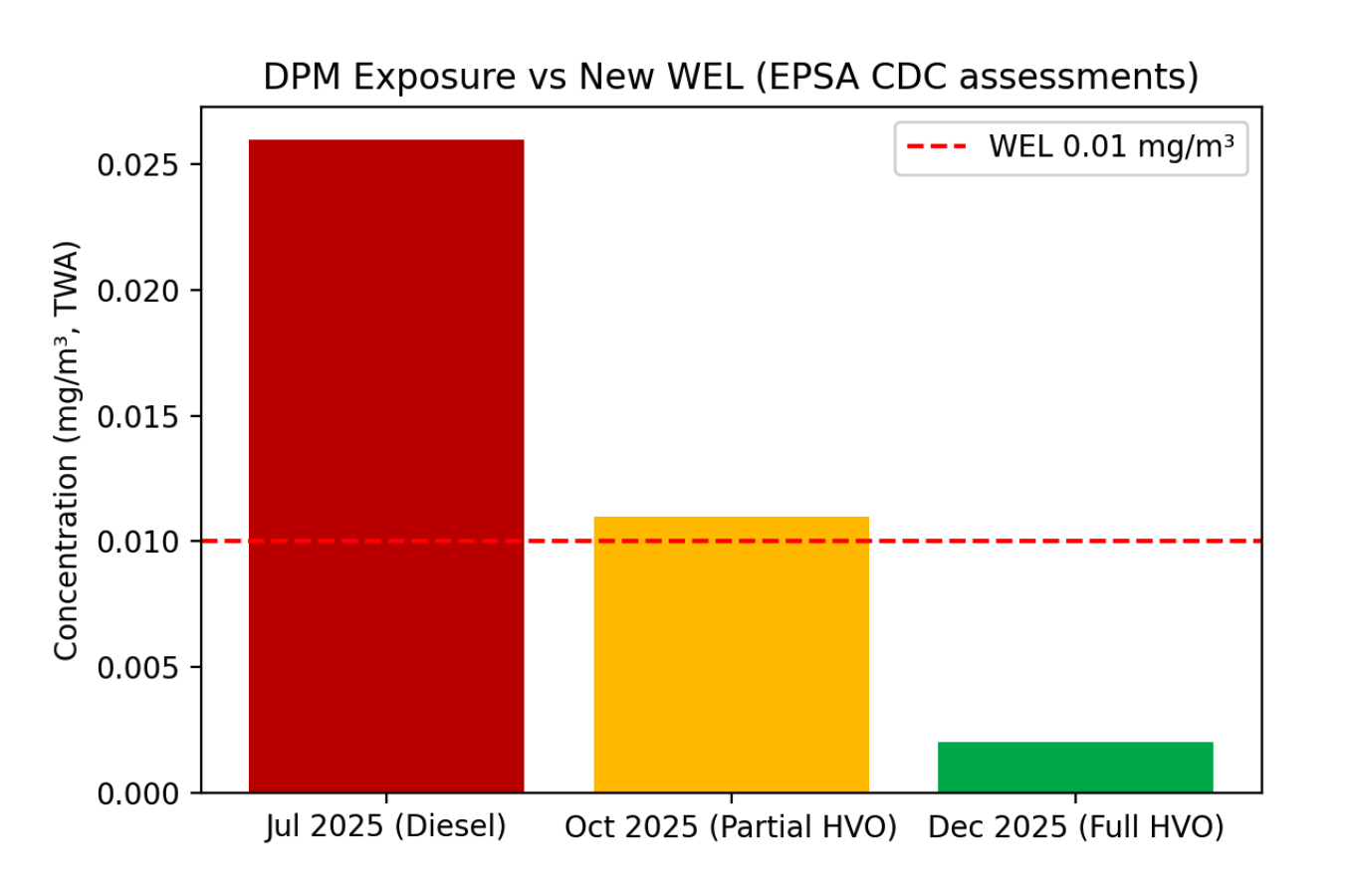
Chart: EPSA CDC DPM Assessments Jul–Dec 2025. Dashed line = WEL 0.01 mg/m³. Occupational Testing in a controlled environment.
Source: Energy Power Systems Australia Pty Ltd (2026)
The EPSA testing results together with independent research, all point in the same direction:
| Source | Engine / Application | Fuel Tested | PM Reduction vs Fossil Diesel |
|---|---|---|---|
| Cummins — QSK95 Test Report (2022) | QSK95 generator set — engineering test cell | HVO100 vs ULSD #2 | 30–60% reduction in PM mass |
| Cummins — QSK95 Field Test (2022) | QSK95 generator set — field conditions, 100% and 75% load | HVO100 vs ULSD #2 | 20–30% reduction in PM mass |
| Cummins — QSK95 Rail Application (2022) | QSK95 heavy-duty rail engine | HVO100 vs conventional diesel | Up to 50% reduction in PM emissions |
| MTU / Rolls-Royce Power Systems — Rail Engine Test (2024) | 12V4000R84 and 12V1600R91 heavy-duty rail engines | HVO100 vs EN 590 diesel | 30–40% reduction upstream of DPF, across load points |
| Rolls-Royce / mtu — Marine Engines, Pilot Customer Testing (2022) | mtu Series 2000 and 4000 marine engines — fleet operations | HVO100 vs fossil diesel | Up to 80% reduction in particulate emissions |
| US Academic Study — Cummins QSB4.5 Off-Road Engine (2022) | Legacy off-road heavy-duty engine — NRTC transient and D2 steady-state cycles | HVO100 vs CARB ULSD | 27–63% PM mass reduction; 14–50% particle number reduction |
| Cummins — All Industrial High-Horsepower Engines (2023) | Full range: QSK19 to QSK95, mining, marine, rail, defence, oil and gas | HVO100 (EN15940) | Up to 50% reduction in PM and smoke — stated in OEM approval announcement |
| PM = Particulate Matter. DPF = Diesel Particulate Filter. ULSD = Ultra-Low Sulphur Diesel. HVO100 = 100% Hydrotreated Vegetable Oil. Results vary by engine type, load condition, test methodology, and whether aftertreatment systems are fitted. OEM test results reflect controlled engineering or field conditions; occupational monitoring reflects real-world site exposure. All figures are sourced directly from the linked publications and OEM announcements. This table is a summary only and should not be relied upon as a substitute for site-specific occupational hygiene assessment. | |||
Why HVO Renewable Diesel Addresses WEL - The Chemistry Explained
HVO renewable diesel is chemically near-identical to fossil diesel. However, HVO's ability to reduce DPM, CO, NOx and SOx simultaneously is not coincidental, it is a direct result of its fuel chemistry. The following table maps each WEL change to the specific HVO fuel property that addresses it.
| Contaminant | WEL Change | HVO Fuel Property | Why HVO Helps |
|---|---|---|---|
| Diesel Particulate Matter (DPM) | New — 0.01 mg/m³ | 10× less Ash Content; 2× less Carbon Residue | Lower carbon residue directly correlates with reduced soot and PM during combustion. Lower ash content means fewer solid particulates. |
| Carbon Monoxide (CO) | ~33% reduction to 20 ppm | Higher Cetane # (77 vs 46 min); less Ash and Carbon | Higher cetane number means superior ignition quality and more complete combustion, producing lower CO. HVO's cetane of 77 exceeds fossil diesel's minimum of 46. |
| Nitric Oxide (NOx) | >90% reduction to 2 ppm | 10× less Aromatics (PAH); Higher Cetane # | HVO contains max 1.1% PAH aromatics vs 11% for fossil diesel. Lower aromatics directly correlate with lower NOx. Higher cetane also improves combustion timing, reducing NOx formation. |
| Sulphur Dioxide (SO₂) | 95% reduction in STEL | Near zero sulphur content (<1.0 ppm actual vs 10 ppm max for fossil) | Near-zero sulphur content in HVO means near-zero SO₂ emissions. Also reduces acid formation in the engine and exhaust system, extending component life. |
| Sources: Safe Work Australia WEL List (Dec 2026); RD2GO fuel specification data. Fossil diesel spec: EN 590 / AS 3570; Australian Diesel Fuel Standard 2025. Renewable diesel spec: EN 15940; Australian Parrafinic Diesel Fuel Standard 2025. WEL limits apply to airborne concentrations only. | |||
To make this visible: burning fossil diesel produces thick black smoke. Burning HVO produces a clean, almost transparent flame. This is not a marginal difference - it is the physical result of removing aromatics, sulphur, ash and carbon residue from the fuel.
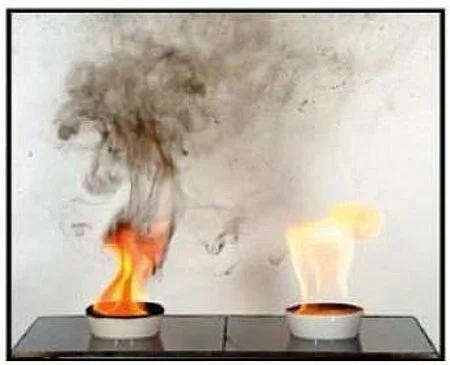
Image: Burning of conventional diesel (left) and paraffinic diesel (right).
Source ASFE.
Why HVO Is the Most Practical Compliance Lever
HVO renewable diesel is chemically near-identical to fossil diesel. It works in every diesel engine with no modifications required and all major OEM warranties intact - CAT, Cummins, Komatsu, MTU, Liebherr, Volvo, and more.
Beyond the WEL benefits, switching to HVO also delivers:
Zero Scope 1 CO₂ under Australia's National Greenhouse Accounts (NGA) Factors - no carbon offsets required
Drop-in compatibility - existing tanks, existing fleet, no infrastructure changes
Higher flash point (up to 130°C vs 61.5°C) - reduced fire risk, safer handling and storage
Greater oxidation stability - longer shelf life, less prone to filter plugging and deposit formation
Can be blended at any ratio with fossil diesel, enabling a phased transition
For businesses near the 0.01 mg/m³ DPM threshold, HVO may be the difference between compliance and a breach - with no capital expenditure. For sites well above it, HVO cuts the exposure gap that engineering controls still need to close.
Key Dates for WELs
Now to November 2026:
Audit your sites.
Conduct a DPM air monitoring study if you operate diesel equipment in enclosed or semi-enclosed environments.
Compare measured exposures against the new WEL values across all four contaminants above.
Implement controls and update WHS documentation, risk assessments, and SWMS.
Individual states are separately assessing how the change applies under their own regulations, so it's worth confirming state implications.
From 1 December 2026: WELs becomes enforceable. Exceeding any adopted limit is a compliance breach. There is no grace period.
Related RD2Go Articles & HVO Information
→ HVO and Carbon: How Renewable Diesel Reduces Emissions Across Every Scope
→ Fossil Diesel, Biodiesel, HVO & SAF: What's the Difference?
→ FAQ: Diesel, the Middle East Crisis & HVO - Prices, Supply and Reserves Explained
→Diesel, Dust and Deadlines: Mining's 2026 Diesel Compliance Guide
Disclaimer: This article provides general information only and does not constitute legal, health, or financial advice. Employers should engage a qualified occupational hygienist to assess their specific workplace exposures and obligations. Consult the Safe Work Australia Workplace Exposure Limits for Airborne Contaminants for the complete list of limits effective 1 December 2026. Data note: WEL values cited in this article are drawn from the Safe Work Australia Workplace Exposure Limits for Airborne Contaminants (effective 1 December 2026). Occupational testing data is sourced from Energy Power Systems Australia Pty Ltd (EPSA), EHS Assessment Reports, July–December 2025.