Lights, Camera, Low-Carbon Action!

Every blockbuster has a dirty secret. It's not even the on-screen drama - it's what's happening behind the scenes. Here's what's fuelling the film industry.

One filming day can exceed the annual carbon footprint of a typical person.

One hour of filming rivals a return flight from London to New York.

Source: BAFTA albert: Clean Temporary Power by 2030

3,370t
CO₂e from an average tentpole feature film - equivalent to 7 million miles driven
70%
of UK productions still rely on diesel generators for on-location power
Up to 90%
lifecycle CO₂ reduction when switching from fossil diesel to HVO100

Where Diesel Hides on a Set

Walk onto any major location shoot and you'll find diesel doing the heavy lifting - quietly, constantly and at massive scale.

Generator banks
Productions in Metro Vancouver run 3–20 diesel generators per day, each consuming ~80 litres over a 12-hour shift. That’s lighting, cameras, trailers, hair and makeup, catering - everything.
Production vehicles
Trucks, trailers, unit base vehicles and transport fleets. Film London’s Fuel Project found 82% of supplier vehicles are diesel - yet only 14% are running on HVO.
Tower lights
Diesel-powered lighting rigs for night shoots, exterior scenes and base camp. Fully compatible with HVO as a direct drop-in replacement - zero modifications required.
Base camp services
Makeup trailers, costume trucks, catering, heaters and office cabins - all typically run on diesel. On a complex shoot, base camp alone can consume 20+ gallons of diesel per 12-hour day.

Carbon Emissions from Film & TV Production

The Sustainable Production Alliance (SPA), a consortium including Amazon Studios, Disney, Netflix, Sony Pictures and NBCUniversal, analysed member company productions and found the average carbon footprint of 3,370 metric tonnes from tentpole productions. The largest contributing factor being fuel consumption with transport and generators alone accounted for roughly 65% of a production's carbon footprint.
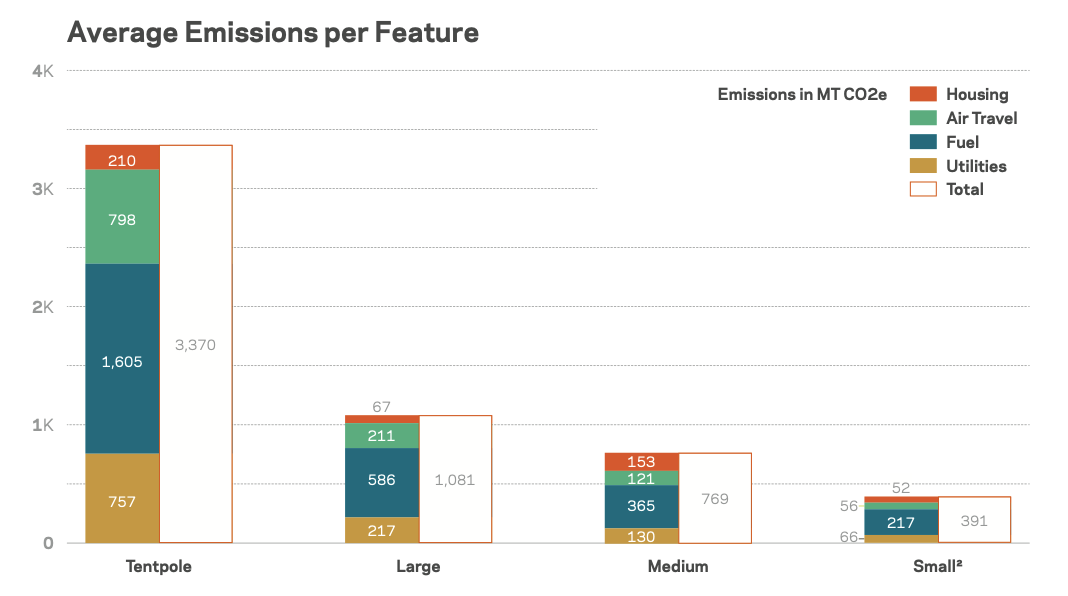
Average Emissions per Feature Film. Source: Carbon Emissions of Film & TV Production  (SPA 2021)

Why Does HVO Flip the Script?

HVO (Hydrotreated Vegetable Oil), also called Renewable Diesel, is made from waste feedstocks: used cooking oil, waste animal fats, and agricultural residues. It's not biodiesel. It's a true paraffinic drop-in: same specification as fossil diesel, same engine, same performance.

So what’s the difference? A drastically reduced emissions profile and a much healthier working environment.

Fossil diesel
- Petroleum-derived
- High lifecycle CO₂
- Significant particulate matter
- NOx & SOx emissions
- Community noise & fumes
- Reliance on crude oil supply
- Volatile pricing
HVO100 (renewable diesel)
- 100% Waste-derived (UCO, animal fats)
- Up to 90% less CO₂
- Up to 40% less particulate matter
- Near zero sulphur content
- Can be used at 100% purity without loss of performance
- Same engine, zero modifications
- ISCC certified sustainability

More Information comparing HVO and Fossil Diesel:

Who is Already Committed to Change

The BBC, ITV, Channel 4, Sky, Netflix, Fremantle and Universal International Studios have all signed a joint Statement of Intent to phase out fossil fuel generators in production by 2030, supported by BAFTA albert's SPARK: Clean Temporary Power by 2030 roadmap.

Netflix and Disney co-founded the Clean Mobile Power Initiative with nonprofit RMI - an accelerator testing battery, hydrogen and hybrid solar systems on active productions. HVO is named as the critical bridge technology while longer-term alternatives scale up.

In Australia, Sustainable Screens Australia (SSA) was founded to change the climate of screen production in Australia through collaboration, education, tools and resources. Partnered with BAFTA albert, SSA has localised the world-leading carbon calculator for the Australian market and in 2025 launched the country's first Sustainability Supervisor training program, backed by Netflix and Screen Australia. Its founding members represent the full breadth of the Australian industry.

Studio - Melbourne, VIC
Docklands Studios Melbourne
Docklands Studios Melbourne is Australia's first fully GreenPower-accredited film studio, now powered by 100% renewable electricity from the State Electricity Commission of Victoria. Productions shooting on its stages automatically access renewable power - and the studio actively supports productions using HVO and battery generators on-site.
Broadcaster - National
SBS
A founding member of Sustainable Screens Australia, SBS has signed a 10-year Power Purchase Agreement for 100% renewable wind and solar energy from ZEN Energy, covering its NSW and Victoria operations. SBS published its first Sustainability Report in 2025 and joined Ad Net Zero as a foundation member.
Training - National
Sustainability Supervisor Program
In 2025, SSA launched Australia's first Sustainability Supervisor training program - a head-of-department level role dedicated to embedding green practices across all production stages. Backed by Netflix and Screen Australia, the program signals that sustainability is now a professional discipline, not an afterthought.

Real Productions, Real Results

These are real productions, real numbers and real results from local and international productions championing HVO, renewable diesel and sustainability in film and TV production.

Feature film - Melbourne, Australia, 2025
Wilderness - an independent Australian production leading by example
Wilderness is an independent Australian feature filmed at Docklands Studios Melbourne and one of the most comprehensive examples of sustainable production practice in the local industry to date. Working with specialists from Sustainable Screens Australia, Sustainable Film Australia and Sustainable Living Tasmania, the production tracked emissions with on-set initiatives including HVO fuel and battery-powered lighting and generators. As writer-director McKenna put it: "The technology serves the story, and the sustainability benefits serve the future of our industry."
Drama series - Melbourne, Australia 2025
All Her Fault - Australia’s HVO trailblazer
All Her Fault was the first Australian production to use renewable diesel at scale. Working with Picture Zero, the production used HVO100 for all unit base generators and deployed a hybrid and electric vehicle fleet. Cited by Sustainable Screens Australia as the local industry trailblazer.
Feature film - Dublin, 2024
Abigail - Universal’s GreenerLight Program
Shot over 57 days at Glenmaroon House in Dublin, Abigail was one of the first films to participate in Universal Filmed Entertainment Group’s GreenerLight Program. The Program is designed to integrate sustainability into every stage of filmmaking, from development and production to distribution. All on-site generators ran on HVO, with hybrid generator technology also deployed. Full case study: Screen Ireland.
Feature film - UK, 2022
Downton Abbey: A New Era - EMA Gold Seal production
Produced by Carnival Films for Focus Features and Universal, Downton Abbey: A New Era used renewable diesel HVO in both generators and vehicles throughout the production - one of the earlier high-profile examples of a major UK feature committing to HVO across its entire fuel use. The film was shot at Ealing Studios, which runs on 100% renewable energy.
Next
Next

Decarbonising Australia’s Working Waterfront